Wednesday, April 2, 2008

Mumbai

In January the AJWS retreat started out with several days in Mumbai. After Thailand, I returned to Mumbai for a couple days before returning to Hyderabad.

I enjoyed Mumbai a lot. I thought it was beautiful and had a completely different feel than anywhere else I'd been in India. It has that grandiose big city feel like NYC. I am aware, however, that I was mostly in the nicest richest parts of Mumbai, and saw art museums, tourist sites, and continental restaurants, and did not see things like the biggest slum in Asia (which is in Mumbai).


The double decker buses and red phone booths are reminiscent of the time of British rule


A few of us visited one of the Jewish synagogues in Mumbai. The next week Lily, Shlayma and I went to the service here, which was run by a Chabad Rabbi. As per order of the Chabad Rabbi, women are relegated to the balcony during the services and don't count towards a minion.


Me and a few AJWS fellows with Ben Zion, an Indian Jew.


They say you can get anything you want in Mumbai - for a price.


A glimpse of the Mumbai airport, and all the many people you meet when you exit. If that's not overwhelming I don't know what is.


Me eating Kulfi ice cream out of a one time use clay pot


People nap everywhere. Look closely.

Monday, March 31, 2008

Birthday party

Our neighbors in the next building came over yesterday with an invitation for their niece Meghana's first birthday party. They own the store on our corner where I buy eggs, and run there whenever we are cooking and realize we are out of an essential such as green chillies or ginger (we buy our veggies at a couple different veggie stores a few blocks away).

The party was at a function hall on the street parallel to ours. We arrived with a box of Indian sweets in hand along with a plastic toy drum that we found at the 25 rupee store (not just because we are cheap, but also because we had no idea where else to buy toys of any kind). They ushered us in and the photographer took photos of us with the baby and her aunts. Then we were given cake, then sat around in chairs for a while waving at people we vaguely know from the neighborhood. Then we went outside and helped ourselves to the buffet of yummy Indian food, which was spiced rice, plain rice, an eggplant dish, an aloo (potato) dish, a gobi (cauliflower) dish, curds (plain yogurt), and gulab jamun and another sweet that I believe was Rajasthani (these neighbors are from Rajasthan, a state in the North North West of India, which means they have somewhat different food, customs, clothes, and speak Hindi and not Telugu). There were many women dressed in elegant sarees and my roommates and I, in kurtas and jeans, felt quite under dressed. Many of the Rajasthani women wore the end of the sarees draped over their heads, as is the custom of some.

We talked with the few people we knew (our immediate neighbors, the Punjabi neighbors who live downstairs and run a homeopathic clinic, and Shlayma's boss from her first NGO) and played with the many kids. I chased some kids around the yard until I was tired from running and ice cream mixed with gulab jamun, and then introduced myself to a Muslim woman with 9-month old twins and proceeded to hold them both. Indians LOVE children, maybe more than other people. One of my favorite things about India is that I can go up to people at a party, in a shop, on the street, in a bus - and touch their kids. I can smile and coo and pinch the cheeks of a complete stranger - and often the parents will smile and try and get their kid to say hello back. Sometimes they will hand the kid to me; I've never been refused when I've asked to hold a child. This might not seem so strange, but imagine in America or England if you went up to a child, perhaps with their face turned away from their parents in their arms, or maybe standing alone in a public area - and began to pat them, poke them, pinch their cheeks! (They are big on cheek pinching here; sometimes my coworkers pinch my cheeks.)

It was quite a shindig, especially for a first birthday party. There was music and a catered buffet and nearly 100 people, and the baby changed clothes at least twice... good times.

Saturday, March 22, 2008

One day in Hyderabad

I went on a day-long tour with Robyn, a friend of an Asmita funder who was in town visiting.
Robyn


The tour guide was really funny - though, apparently, only to me and Robyn. He kept yelling "Challo! Ayie!" ("Let's go! Please come!") every five minutes.

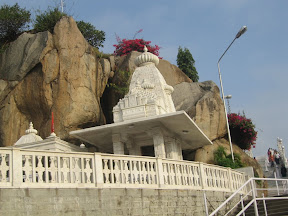
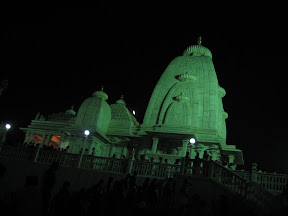
The White Temple was built in the 1970's. You take off your shoes to enter and get to enjoy walking barefoot on the smooth cold white Marble.

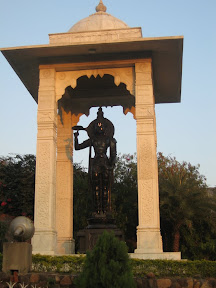
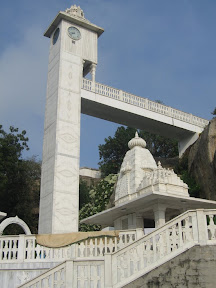
Photos at the white temple, including one I took at night when I was there with my roommates


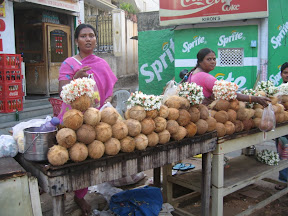
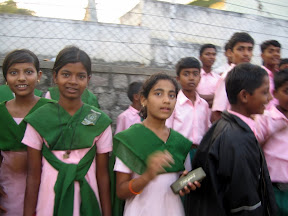
Women selling coconuts for Pooja purposes outside the Temple; school kids waiting to go in the Temple.


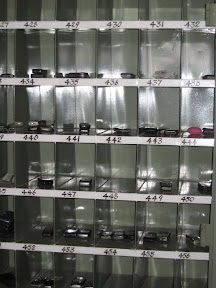
Cell phones and cameras are strictly forbidden inside the white temple. When you walk in the locker room, you can hear a handful of cell phones ringing at once from these shelves.


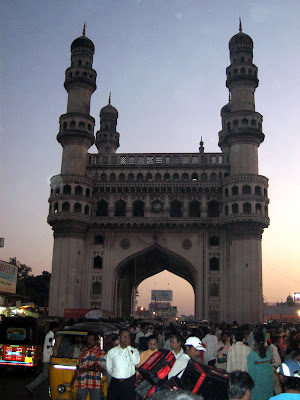
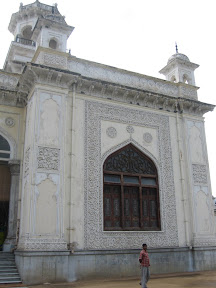
We drove around the Charminar but didn't get out. I took this photo another time when I went there with my roommates.


The Nizam Museum
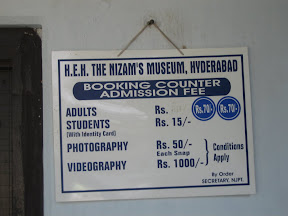
Reason there are no photos from inside the Nizam museum (Rs50 = $1.25 per photo)


Lots of places in India charge extra above the ticket price for cameras and video cameras. Also many sites charge tourists ten times more than Indians. I made my case for paying Indian prices - I work and live in India - and everywhere but Golkonda let me in at Indian ticket price.

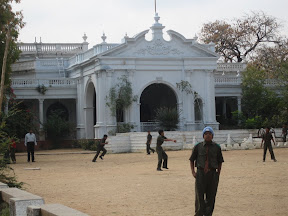
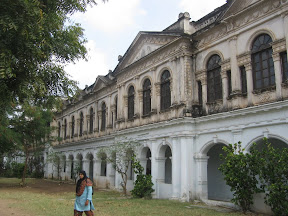
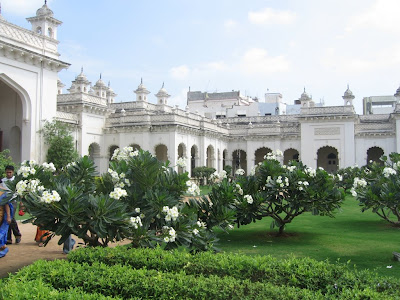
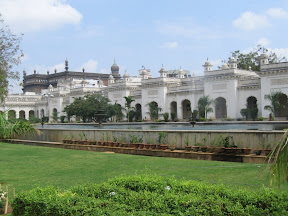
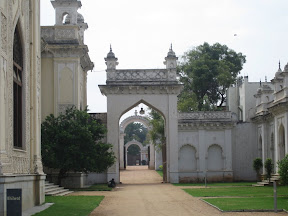
Nizam Palace


We stopped for a much-needed lunch at a restaurant with a veg buffet. I was eating with my hands (as is the tradition in South India) and felt something in the baigan bartha that didn't feel like eggplant. I brought it up to the counter and asked them what it was. "It's Brinjal ('eggplant' in India English), ma'am." "No," I said. "This is meat." About five other workers came over and began to examine the hunk of flesh on my plate, and finally came to the conclusion that it's mutton (lamb). Another worker made a new plate from the buffet for me and tried to hand it to me, but I refused to take it. I had almost finished eating anyway, and could easily make myself another plate if I had wanted (after all, that's how I got the first two plates, isn't it). As I am used to complaining at restaurants both because I work in one and because I was vegan for five years and got used to sending about 50% of food ordered at restaurants back for alterations, I went on. "There was mutton in my brinjal! This is a veg buffet!" I said. "This is India! You can't do this here!" As if I had said the magic words, a worker refunded my buffet money (to Robyn, who had paid) and gave both me and Robyn mango ice cream with carmalized apricot (mmmmm). Seriously though... who does that in India.

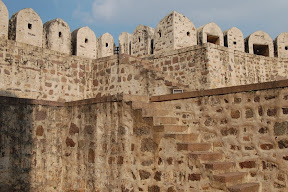
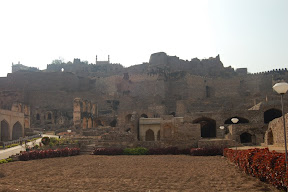
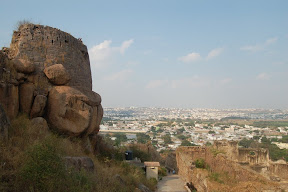
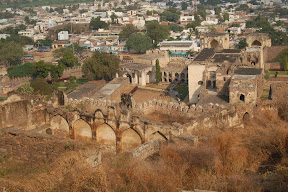
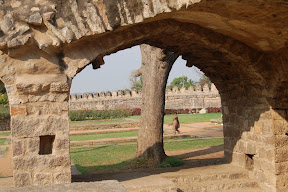
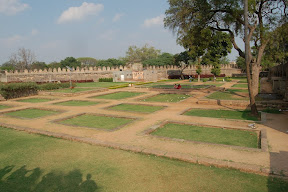
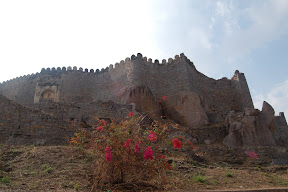
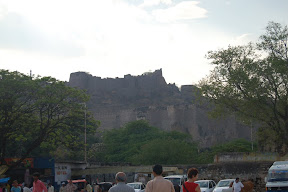
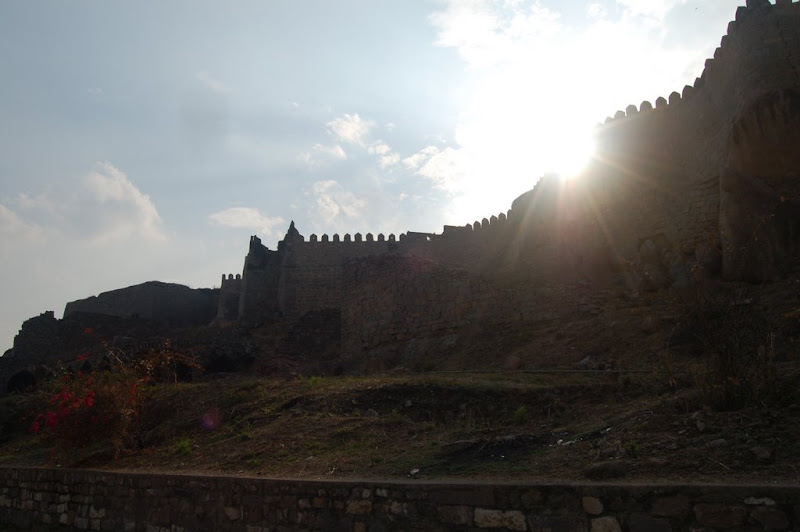
Golkonda Fort

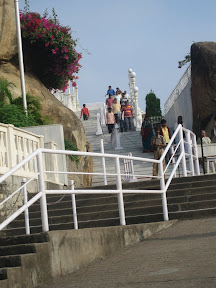
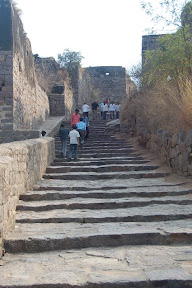
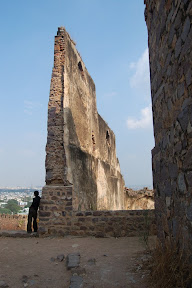
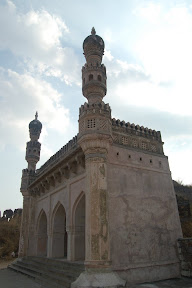
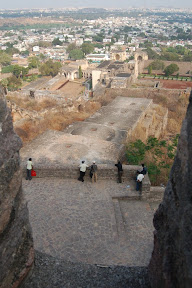
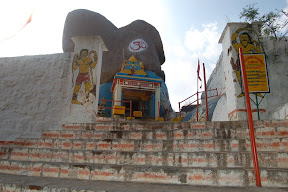
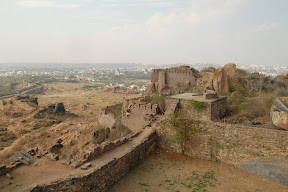
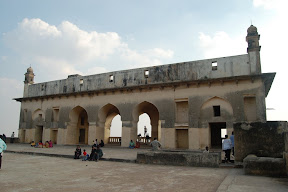
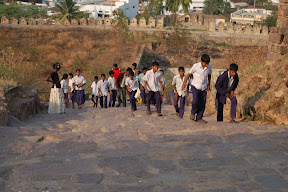
Golkonda is beautiful. There are around 350 stairs to get to the top. The Temple is on the way up, the pavilion building structures are at the top, and has giant Andhra rocks everywhere. There were a handful of teenage boys trying to take out photo or trying to take photos with us (we refused, but allowed some girls to take photos with us). There were many young couples here, and at the other sites we visited, seemingly hiding in a tourist venue where no one they know would find out about their secret trysts.

Sunday, March 16, 2008

So-called enhanced interrogation techniques

Although I often use terms like "third world" and "developing" in my speech and writing in the interest of simplifying communication, I find these terms problematic. While I admit that I have seen India literally developing before my eyes during my 7 months here, the idea that a country is "developing" implies that they must try to become like "us" - as if they development were a linear process and and each country falls somewhere on that line. The term also implies that one developed nation is superior, while another developing or undeveloped country is behind, lacking, inferior, or, as they say in India, "backwards."

I take issue with the idea that one place is backwards while another is not. People create a mental link between the idea of infrastructural development and the idea of moral development, and moral, political, and structural development. In their minds, and in the discourse and terminology used, developing country = developing people. We read about people dying of AIDS, malaria, getting hit by buses, women burned alive by husbands, children trafficked for sex tourism purposes (as if these problems don't happen in the "developed" world). But yes, there are many problems with corruption and lack of infrastructure in India, which often has detrimental results for citizens, including in sickness, death, acute poverty, failure of aid to reach those for whom it is intended, and a host of other problems. Modi, the head of the Indian state of Gujarat (and was also chief minister during the Gujarat riots and has been criticized for his role in this) whom an Indian coworker once equated with Hitler, perhaps admitted to killing his opponent and justified it saying he deserved it and he did what needed to be done.

But what about the developed world? Is there such a vast distinction in policies and attitudes of our politicians? Several days ago when I read that Bush vetoed an anti-torture bill, or "interrogation limits" for the CIA, these questions were what ran through my mind. I know that "water-boarding" has gotten a lot of attention in recent months, but the others are equally if not more disturbing to me.

This list is taken from a BBC article on Bush's recent veto of the anti-torture bill.

CIA 'ENHANCED INTERROGATION' TECHNIQUES
Water-boarding: prisoner bound to a board with feet raised, and cellophane wrapped round his head. Water is poured onto his face and is said to produce a fear of drowning

Cold cell: prisoner made to stand naked in a cold, though not freezing, cell and doused with water

Standing: Prisoners stand for 40 hours and more, shackled to the floor

Belly slap: a hard slap to the stomach with an open hand. This is designed to be painful but not to cause injury


My point is not exactly that India is not developing, or that America is more backward than it pretends... let's just say that in my opinion, Bush and Modi are in a similar camp.
my space counters Travel Top Blogs

About Me

United States
I wrote this blog while working at a women's resource center in Hyderabad, India through a social justice fellowship through American Jewish World Service.

When I think of India, I think of...

I would like Planet Bollywood better if it had: