Thursday, January 31, 2008

Saree

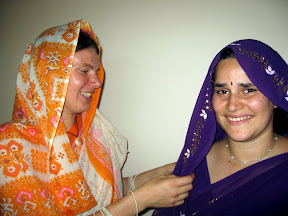
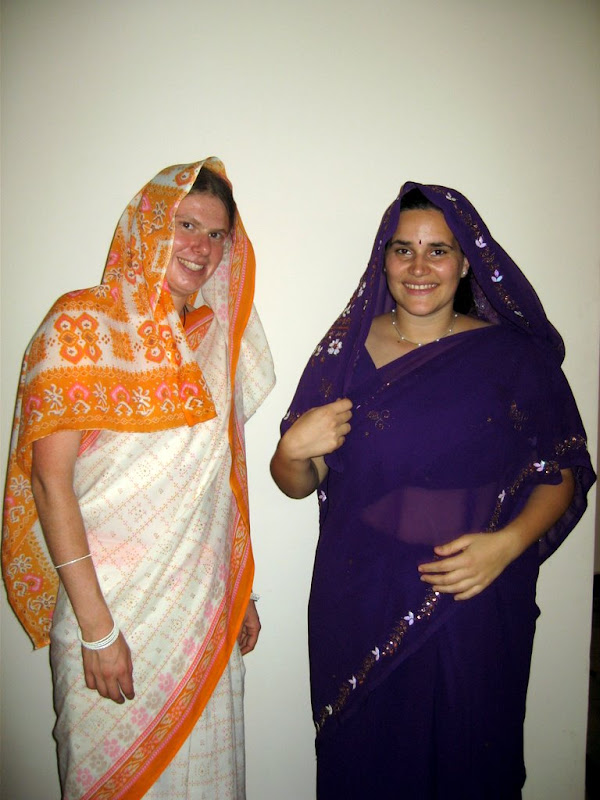
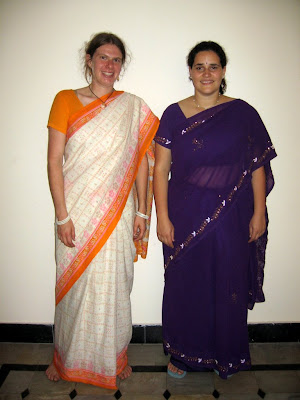
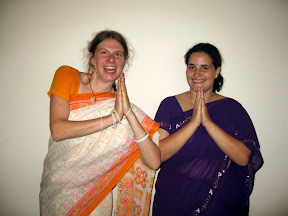
So I finally got my saree made, and Leah is visiting from rural coastal Andhra Pradesh and helped me tie it. Leah owns four sarees and wears them regularly; this is one of her work sarees. Mine is also a work saree, meaning it's a saree to wear to work. I also own a wedding saree, which I can wear to any weddings I get invited to. My roommates and coworkers tease me for only wearing purple and blue here, which is the majority of my Indian wardrobe. It is only fitting that my first saree is purple.

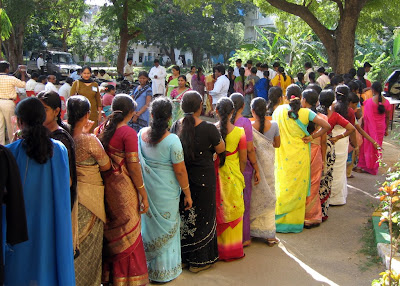
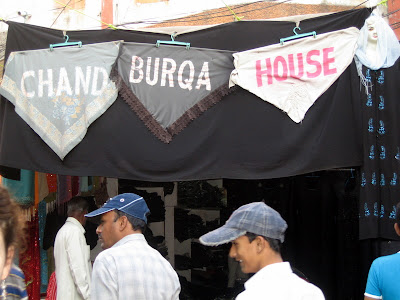
People wear sarees differently in different parts of the country. This is how we wrap sarees in Andhra, but we saw women wearing it differently in Mumbai. I'm sure we saw it differently at times in the North during orientation, but we didn't know enough about variations on saree-wearing back then to identify the differences. Traditionally, girls start wearing half sarees, which is a skirt, blouse, and piece of cloth acting as the front wrapped-around piece, when they begin menstruation, and then wear a full saree when they are married. However, today salwar kumeez's (pants and long kurta (top) suits with a matching dupatta (scarf) are quite common, and both unmarried and married women wear full sarees. Sometimes we see women wearing sarees over their heads, if the sun is hot or if they enter a temple. The Muslim women that I know in India also wear sarees or salwar kumeez's under their Burqa's (if they wear a burqa, which not all do).

People here get extremely happy when we wear Indian things. I wear a bindi ("dot") to work everyday and get reprimanded by Padma, our tea lady, if I forget to wear it. Sometimes they will veto our bindis - both Lily and I have had coworkers forcibly remove our bindis and replace them with stickers they felt were more suited to our faces (Lily wore a bindi that was too large; I wore a tiny silver dot the size of a comma, and a coworker took it off my head, removed her bindi from her own forehead, and replaced mine with hers). For Leah and Lauren, who live in the village, if they wear the saree, they need to wear the bindi, and the matching necklace and earrings and bangles, and the positive reinforcement they get form coworkers, who are just so super excited to see them all dressed up, is enough that they wear the whole shebang quite frequently.

Monday, January 28, 2008

Vacation catch-up - Agra

My father, Milos and I hired a car to go to Delhi. At 7am our driver met us outside our hotel and we began the journey to Agra. He was a nice guy and my dad enjoyed talking to him, but I was annoyed because he took us to a really expensive tourist rest stop for lunch and when I complained about the price he said it was "normal" for India and I was like look pal I live in India, I'm not stupid these are American prices and he just smiled silently. He also neglected to mention that the Agra Fort closed at sunset (not sure if he was lying) and drove us past there saying we couldn't go inside. On the way home he took us to a marble dealer, and probably got a coupon or some money for doing so. He seemed mad that we didn't buy anything, as did the store owners. It's a cheap trick used by auto drivers and apparently other more costly drivers as well. Sometimes it is nice though because you get to see interesting wares, and if you have nowhere to be it is a nice thing to do for a nice driver (go in and check out their "friend's" merchandise).

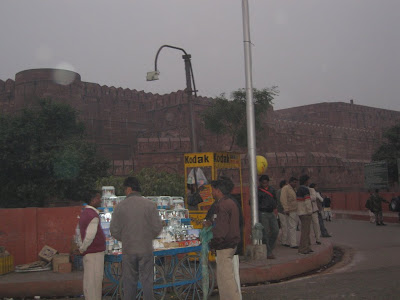
Photo at dusk outside the 'closed' Agra Fort.

Outside the Taj Mahal, we paid foreigners price in rupees (they recently stopped accepting US dollars because of the declining value). After checking our sweatshirts (Delhi and the North is cold at this time of year!) and other non essentials and collecting our free water bottle (part of the international ticket price) we waited in line only to get to the front and be told no bags, no purses, no exceptions. We cursed and went back to the locker room, placing as much as we could in pockets and in my camera bag (which turned out to be an exception). Returning to the line, I was ushered through after being frisked behind a tiny curtain in the women's line, and waited on the inside for Milos and Chuck. As men in public places far outweighs the number of women, lines for women at temples, movie theaters, sites, etc. are generally much shorter.

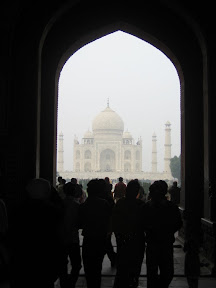
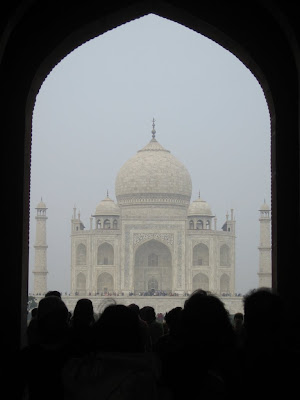
There is an archway that you walk towards, through which the Taj Mahal slowly begins to materialize.


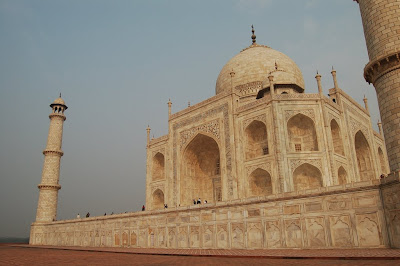
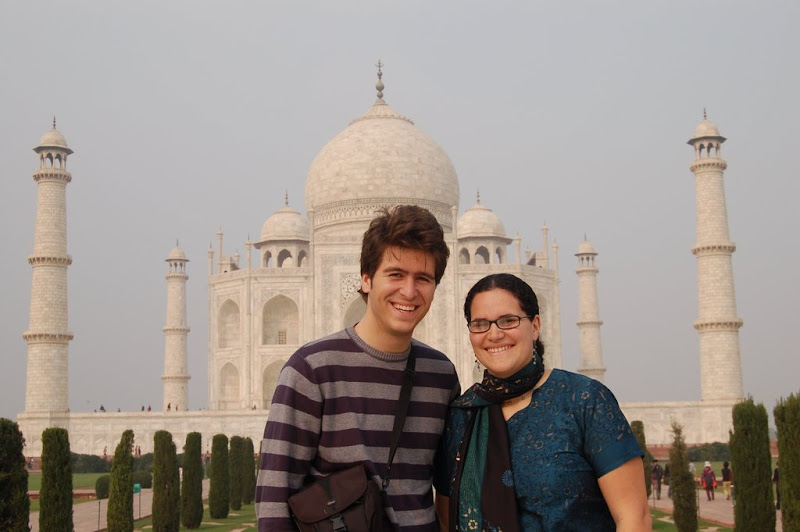
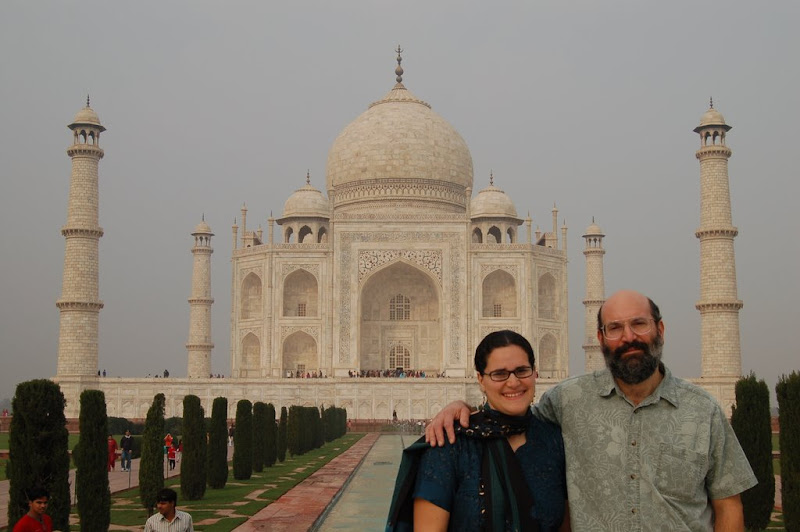
We spent hours at the Taj simply enjoying the view and basking in its glory.


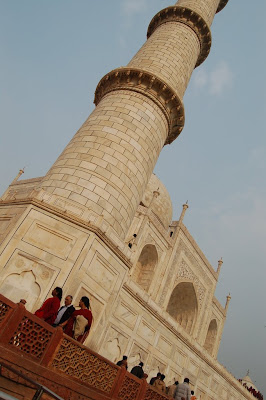
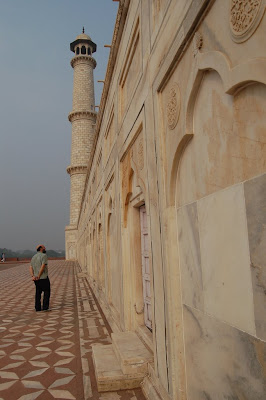
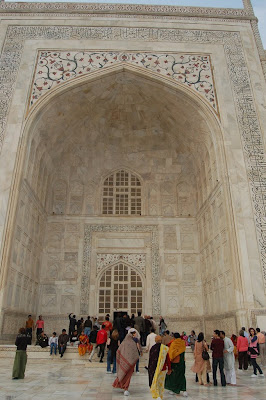
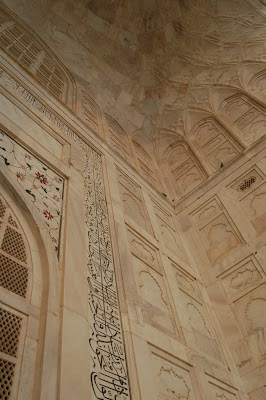
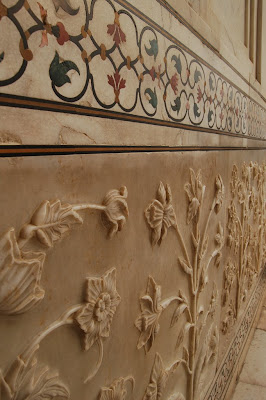
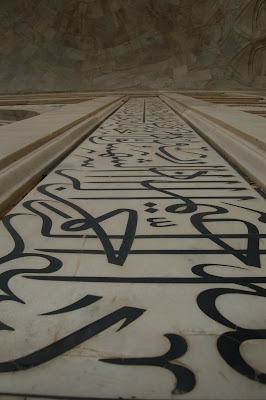
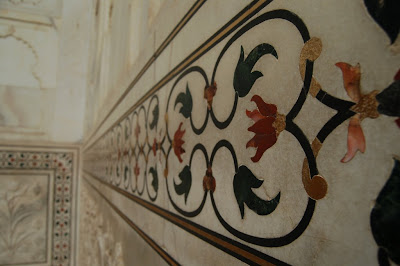
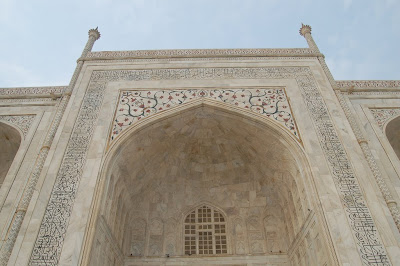
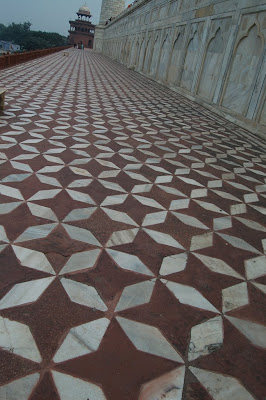
Up close the Taj is no less impressive, with intricate details, beautiful carving, and extensive marble work.


Care hire to Agra: $120 (US dollars)
Ticket price: Rupees 750
Photos taken: 240
Postcards purchased: 12
Tips for "free" lockers: Rupees 10
Seeing the Taj Mahal in person: Priceless

Sunday, January 27, 2008

Vacation catch-up - Delhi

My father, Chuck, and my friend Milos came to visit me for two weeks in early December and due to having nearly 1000 photos and being extremely busy, I have until now neglected to post about the experience. We spent a week in the middle of their visits all traveling together to Delhi, Agra, and Varanasi.

Delhi was our first stop. We flew there and stayed in the ritzy Connaught Place. One day we went to Old Delhi.

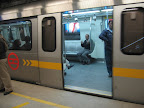
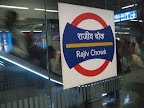
We took the uber snazzy Metro, which has a futuristic look with its metal seats, digital signs, and clean appearance. The only difficulty is the lines/queues for the tokens and for exiting at each stop, as well as the moshpit-quality-shoving that you experience getting on the train.


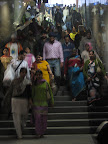
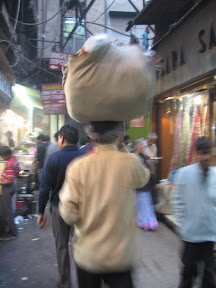
I showed them around the streets of Chandi Chowk in Old Delhi as best as I could remember. We all got a bit overwhelmed by the narrow alleys filled with people, cyclerikshaws, motorbikes, vendors, smells, sounds, sights, but sensory overload is sometimes just part of the experience of India.


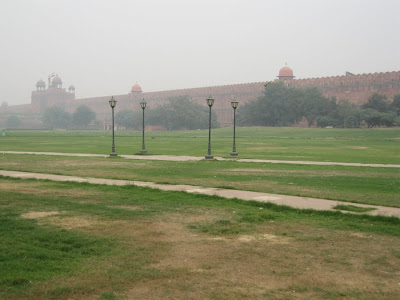
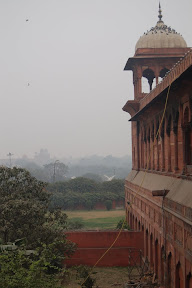
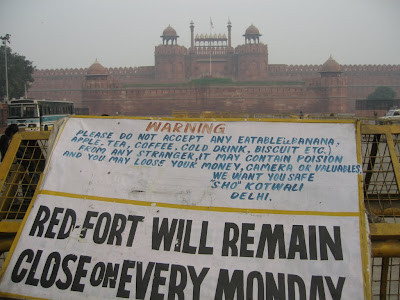
We went to the Red Fort on the way to Jama Masjid, and walked along the gate the whole length of the building.


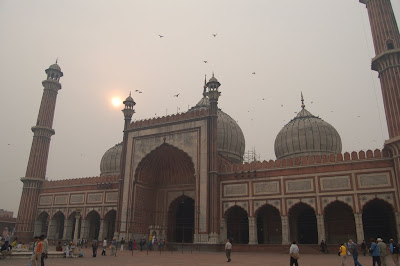
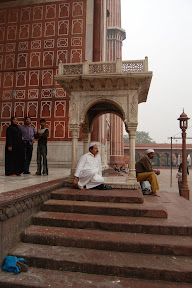
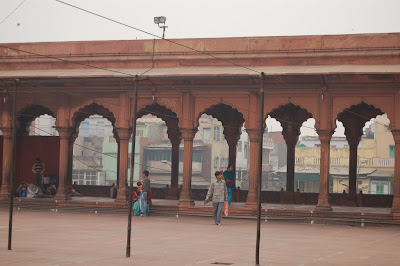
We went to Jama Masjid, a gorgeous mosque in Old Delhi.

Friday, January 11, 2008

Privilege

At each stop on the super modern and fancy-looking Delhi Metro, the recording of a male voice announces the name of the stop and implores passengers to give up their seat to those who are elderly, physically disabled, and ladies. Upon hearing each announcement, I promptly rolled my eyes, and looked around at the other women on the train, wondering if they felt similarly annoyance at this condescending equation.

Back home in Hyderabad, I take the bus home from work everyday with my coworker, Anu. The buses in India can be dangerous; sometimes one has to jump on or off the bus during what couldn't quite qualify in the States as a rolling stop. Buses in Delhi are constantly in the paper for running people over, or having people die as a result of speeding up as people are trying to jump aboard. The Hyderabad local buses have two entrances, both on the left side: the one in front for women, the one in back for men. The rationale is that the woman's door is safer, presumably because the driver can see when people have finished climbing into / exiting the bus, and can see if women are getting harassed. When crowded, sometimes one cannot even get off the bus when desired because it is impossible to get through the crowd. Roughly half of the seats towards the front of the bus are reserved for ladies: sometimes they are marked with signs; on other buses it is simply done, despite lack of signs. The first two rows on the left front side of the bus are reserved for elderly and physically disabled persons.

When I get on the bus, I can walk up to men sitting in the reserved-for-ladies seats and make them go back so I can sit. When I, or other women enter a bus, men will generally get up and move backwards to another seat or area. Sometimes this doesn't happen: too often men will refuse to give their seats to women, or people will fight over the disabled/elderly seats. Images are conjured of blacks rushing to the back to give way to white passengers and that of Rosa Parks being arrested to the minds of anyone who has studied the Montgomery bus boycotts. Though the comparison is symbolic, obviously not parallel, being a white privileged American in India riding the bus with people who are working class or most likely somewhat poor and having them automatically jump up from their seat as soon as they see me feels strange at best.

Do I have some sort of weakness, an ailment, a desperate need inherent in being a woman that makes it necessary for me to receive special treatment, guaranteeing me a bus seat over the majority male passengers? I don't like the idea that I would need a seat, that men should give up seats for women, that on the Metro women's sitting needs are equated with that of elderly and disabled bodies persons. This implies that women are weak, that they need special treatment because they are inferior and require protection. And yet...

Women here tell me that buses are perhaps the place where they face the most harassment from men. There are less women out in public compared with men, so although they might need less seats reserved (or none at all), a measure like that might ensure women would feel more safe to ride the bus and feel safe going out in public. Admittedly, I like that when I enter a bus, I am often given a seat. As the only white person in any given Hyderabadi bus (unless my roommates are with me), I attract a range of stares when I am on the bus, and standing at the front of the bus invites an audience of curious, amused, confused, and creepy looks. My NGO is currently working with the bus department to ensure that reserving bus seats for women is practiced. Evidently they feel it is an important women's issue.

My Intro to Women's Studies professor Dr. Shimizu posed the question: If we could achieve equality, would you be willing to give up certain perks? If we could have equal pay and not fear rape and domestic abuse, would we be willing to part with free entry to clubs on "ladies night" and the custom of men paying for dates? She said that in order to achieve equality both parties need to be willing to part with certain aspects of their privilege. If we had to give up reserved for women bus seats and insulting loudspeaker Metro announcements in exchange for someone guaranteeing that women would not having to face harassment or "eve teasing" in buses and in public, I would unquestionably agree that seat reservation based on sex category should be abolished. But one will not simply result from the other: giving up bus seat reservation will not make it so women can travel by bus without fear - it might inadvertently have the opposite effect. Changing laws and regulations is a necessary part of implementing social change, but does not cause social change in itself.

In working for a women's resource center, doing my best to subvert notions of natural gender restrictions by example, and living as best I can without fear in a country and world where women still face extreme inequality in various forms, I am doing my best to effect change for women in society and of gender as a concept. Until change occurs, however, I will continue to participate in what I see as simultaneously a privilege and condescension, and sit in the reserved for ladies seats on the bus. And roll my eyes at the Metro announcements. And fight for women's equality.

Wednesday, January 2, 2008

A Story: Mr Moyo goes to the Doctor

'What is your job?' asked the doctor.
'I am a farmer' replied Mr Moyo.

'Have you any children?' the doctor asked.
'God has not been good to me. Of 15 born, only 9 alive,' Mr Moyo answered.

'Does your wife work?'
'No, she stays at home.'

'I see. How does she spend her day?'
'Well, she gets up at four in the morning, fetches water and wood, makes the fire, cooks breakfast and cleans the homestead. Then she goes to the river and washes clothes. Once a week she walks to the grinding mill. After that she does to the township with the two smallest children where she sells tomatoes by the road side while she knits. She buys what she wants from the shops. Then she cooks the midday meal.'

'You come home at midday?'
'No, no she brings the meal to me about three kilometers away.'

'And after that?'
'She stays in the field to do the weeding, and then goes to the vegetable garden to water.'

'What do you do?'
'I must go and discuss business and drink with the men in the village.'

'And after that?'
'I go home for supper which my wife has prepared.'

'Does she go to bed after supper?'
'No, I do. She has things to do around the house until 9 or 10.'

'But I thought you said your wife doesn't work.'
'Of course she doesn't work. I told you she stays at home.'

(Source: Presented by the Women and Development Sub-committee Ministry of Community Development and Community Affairs, Zimbabwe to Women's Regional Ecumenical Workshop, 26 June 1989, Harare, Zimbabwe).

Saturday, December 29, 2007

A day in the life

A friend of mine asked about my day-to-day activities, and I thought I would share it here.

On weekdays I get up between 7:50-8:20am. I put together some kind of food for lunch, either packing leftovers from dinner or cooking something new. At work we each bring a container of rice for ourselves, and then a dish to share (and sometimes also a bit of curd (plain yogurt) to share). I generally bring an Indian-style omelet (eggs, onions, green chili's, salt, chili powder, tumeric); potatoes with veggies and spice; veggie stir fry (sometimes with soy protein chunks which are available at our grocery store); egg fried rice with veggies; dal (lentils); chinese stir fry (tofu, veggies, soy sauce or ginger-garlic sauce). I also sometimes cook the night before so I don't have to cook in the morning.

If Lily is showering, she heats water for me on the stove after she is done with hers; if she isn't I get up and put on a pot of water for myself, which I then add to a 3/4-full bucket of cold water from the porch tap, or if that tap isn't working (as is sometimes the case), the tap in the other bathroom. I use a pail to use the now warmish water from the bucket to shower and wash my hair. (Even though I shower every day, sometimes when I rub my skin at night bits of black dead skin rub off. This is because of the pollution I am exposed to commuting to and from work, and just living in a polluted city. Even more disturbing is that sometimes my snot will turn black, filled with soot from the air. Yum.) I use Herbal Essences products, my brand from home, which I buy here in my supermarket for about the same price as Indian shampoo and conditioner I've seen here.

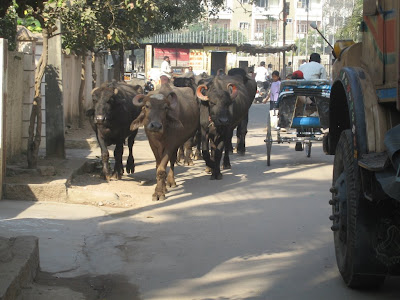
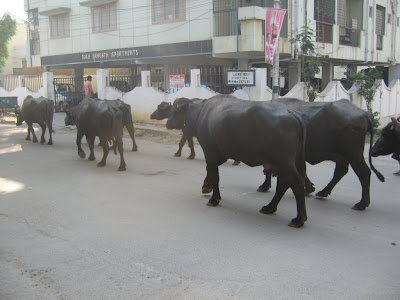
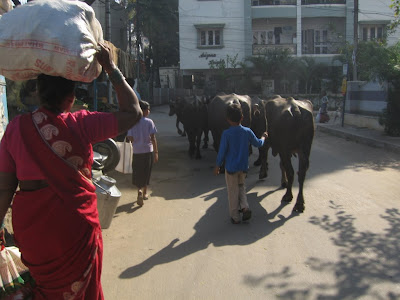
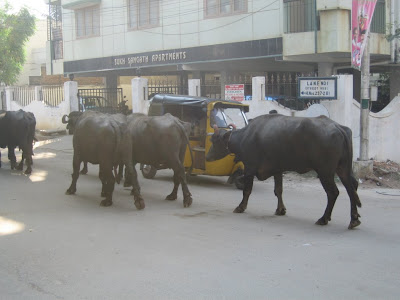
I get dressed in one of my 6 Kurta's (Indian tops) which I pair with Salwar pants and a dupatta (scarf) or my capri's or jeans, eat eggs or mango cornflakes with soymilk for breakfast, and head out the door with Lily, in search of an auto that will take us to work and charge us on the meter (usually not a problem to find). Lily takes me the 10-20 minutes to work, then takes the auto on to her work. Alone it costs me about Rs 30 ($.75); she pays about Rs 50 for the ride. I then walk about 10 leisurely minutes to work, stopping to watch/photograph the water buffalo that more often than not are walking the same route as me, sometimes guided by little kids or a man whipping them with a small stick, sometimes seemingly guided by themselves. Some of them have painted red horns.
My office starts at 10:00am and because I carpool with Lily, I arrive early and am the first to arrive besides our tea lady, cleaning lady, and chore boy. After taking the lift (elevator) to the fourth floor, I remove my shoes and place them in the shoe rack before walking into the office. At work I do various cool things, which most recently has involved creating a 30-day gender and human rights course that we intend to put on for college kids. 1:00pm is lunch, which involves us all putting our rice on our stainless steel plates and passing our other dishes around so everyone gets a bit ("Teskondi" they tell me, which means "take" in Telugu). Padma, our tea lady, puts two bottles of water and a couple cups, along with a bunch of stainless steel plates and spoons, on the plastic table cloth which she puts on the table/s. We use our right hands to eat, and our left hands to pass things, rip roti pieces (thin bread), serve ourselves from the stainless steel tiffins ("Boxes" they call them; we would call them metal tupperware) with spoons, and drink water. Water is consumed, whether from a communal or personal bottle/cup, by holding the container about 2 inches above one's mouth, tilting one's head back, and pouring into one's mouth. I can barely pour more than a mouthful without having to stop and swallow; they can poor entire full cups of water seemingly down their throats. Even little kids drink water this way; I have found it difficult to learn, but fun to try.

My office closes at 5:30, at which point I walk to the bus, usually with my coworker, Anu, who lives near me. It takes between 30-90 minutes to get home, depending on how long we need to wait for a bus, how long it takes for a bus to stop (sometimes they won't stop), and how bad the traffic is. The bus from work to home costs Rs5 which is about $.13 (thirteen cents). I exit the bus, occasionally jumping off as it slows in traffic nearer to my house than the bus stop is. I walk home, often stopping to buy vegetables on the way.

For veggies, we go to a more-or-less permanent vegetable stand, where we pay a fixed price per kilogram for our purchases. We are given a wicker or plastic bucket to collect our veggies in. I spend about 80-100 rupees ($2-2.50) on a huge bag of veggies: a dozen onions, a dozen tomatoes, garlic, eggplant, potatoes, cabbage, and carrots. When we want fruits we go to a mobile stand (usually a wooden cart with wheels that the vendors take wherever they feel business is best) and get whatever is in season. Mangoes haven't been available since we got here; custard apples were in for Oct-Nov (and I am going through withdrawal now that they are gone); oranges just came in season. It's strange eating produce based on what is seasonally available, though I suppose it's stranger living in a place where you can get any produce all-year round. We get the rest of our food from local grocery stores, such as rice, lentils, olive oil, honey, soy milk, tofu, Gouda, juice, cereal, pasta, jam, bread, papadum. We actually eat a mostly vegan and wheat-free diet in the house, with the exception of eggs and toast for breakfast, and cheese as a treat.

We spend between 1-2.5 hours cooking dinner every night. We have a rice maker, several pots, a microwave, two burners and no oven. We have a medium-sized fridge that our landlord gave us.

Other activities include going out with our friends, watching movies, having friends over for dinner, going to good restaurants, reading, writing snail mail (email me if you want a postcard!), doing laundry in a bucket, going to tourist areas such as the lake or a park, cooking, chasing mosquito's with a tennis racket-shaped bug electrocution toy, and for me most recently, sleeping in a mosquito net because we suddenly have tons of mosquitos. I brush my teeth with filtered water because the tap water is bad (unsuitable for drinking).
Saturday, December 1, 2007

"Can I ask you about your dot?"

After work, I was walking to the bus with Anu, who lives near my neighborhood. She was saying that I would be the center of attention when I went to the communalism workshop in the village of Mahbubnagar. I told her I don't mind when women and children stare at me, because the women generally smile back when I smile at them, and the kids like to say "hi! hi! hi!" and are super cute. It's the men staring that bothers me, because it is creepy and if I were to smile at them, as I do with the women, it would be interpreted disturbingly incorrectly. I know I'm a foreigner, I told her, but I still don't like the assumption that I am rich/easy/exciting just because I am a white woman. Why do all these men have to stare at me?
Anu was silent for a moment, and then asked me what would happen if an Indian woman came to America - would they get similar treatment?

"Oh no," I said. "They might stare, but it would be less sexual and more just because she was different... and we might talk louder to her, even if she spoke perfect English because people who speak English with an Indian accent are assumed to be intermediate in their English-speaking abilities, and ask her if 'Indian' was her first language... and we might institutionally discr iminate against her, but just a little, and somewhat subtly... and we might not stare so overtly in public, but instead fetishize her... And if it were an Indian Muslim women who wore a Burqa we would definitely stare, and comment in an airport that she would be thoroughly searched, because she is likely a suicide bomber, or part of an islamofacist terrorist mutiny, and talk openly about how oppressed she was by her men because she has to wear that awful thing, because clearly no woman would ever willingly choose such a burden, and...

"Oh."

my space counters Travel Top Blogs

About Me

United States
I wrote this blog while working at a women's resource center in Hyderabad, India through a social justice fellowship through American Jewish World Service.

When I think of India, I think of...

I would like Planet Bollywood better if it had: